Monday, March 28, 2011

Alison Gill: Deconstruction Fashion

By Nicolle D'Onofrio

Context: 1998, Fashion Theory Textbook
Author: Alison Gill; Current lecturer of visual communication design at University of Sydney with a PHD in "Wearing Clothes".
Approach: Academic with a mix of Theoretical
Point of View: Deconstruction Fashion, which should not be defined as a negative critique of the fashion industry, serves to change the discourse of fashion away from its established, seemingly intrinsic, codes.

Terms:
Deconstructionism:
The "undoing" of fashion (see video examples) to create new pieces of "deconstructed" fashion.
Le Destroy: Rebellion style of fashion Gill associates with deconstructionism. Facets of Le Destroy include anti-fashion, recession-zeitgeist, eco-fashion, and theoretical dress
Anti-Fashion: Rebellious form of fashion used to negatively critique normalized fashion codes.
Zeitgeist: literally "spirit of the times"
Ontology: The branch of metaphysics used to deal with the nature of being
Margiela: Fashion designer described by Gill as the first major deconstructionist designer of the 1980's
Derrida: French Philosopher who created "deconstructionist theory" in the 1960's.


Summary:
Alison Gill's "Deconstruction Fashion: the making of unfinished, decomposing and re-assembled clothes" describes the theory of deconstructionism as it relates to fashion. She begins with a history of the term "deconstruction," describing its original terminology as a philosophical theory used to critique language and codes. Deconstruction was then practiced by architects and graphic designers in the 1980's when Martin Margiela began designing deconstructionist fashion. Margiela would take apart the linings from vintage dresses and sell them with the darts, seams, and zipper entirely visible, rethinking the role of fashion to hide its magical construction to create a suitable garment.

Gill then moves on to relation "deconstructionism" to "Le Destroy," describing the practices of anti-fashion (which has some deconstruction elements but is far to focused on negative critique of the industry), recession zeitgeist (which creates a political connection between the instability of eastern european ideologies and an instability of fashion codes), eco-fashion (which emphasizes the use of recycled/eroding materials to send a message for more environmentally friendly textiles), and theoretical fashion (most closely related to deconstructionist fashion in that it links philosophical ideologies to the practice of fashion). Gill claims that "deconstruction fashion liberates the garment from functionality by literally undoing," making the reader ponder exactly the what the functionality of fashion is.

Gill then goes in depth on the term "deconstruction" and its named critique by creator Jacques Derrida. Derrida claims that deconstruction should not be linked to a negative critique (it is not to be called 'destruction') on society, or in this case the normalized fashion industry, but rather the introduction of a new discourse in the way we view the working of social codes. While this type of thinking may be related to post-modernism Derrida is also skeptical to place this label on the term in fear that it creates a temporal confinement that is aligned with a movement rather than a new way of thinking and rethinking.

Lastly, Gill discusses the effects of Media on deconstruction fashion. Gill warns that deconstruction should not be linked, as it has been, to style, but rather the sole mechanics of the creation, un-creation, and re-creation, of a garment. Gill proposes that this type of stripping down of clothing reveals certain truths about the fashion industry that change the way we look at fashion today.


Relevant?: I believe these terms and style of thinking to be relevant today, especially in our claims that we live in a post-modern world. I think the reinvention of not only fashion trends, but the way in which we see and define fashion creates, in itself, an aspect of power over society in that it forces us to think and rethink our own normalized predispositions.

Tuesday, March 22, 2011

The Power of Appearances


�If discourse must triumph over something, it is not over fantasies and hallucinations heavy with meaning and misinterpretation, but the shiny surface of non-sense and all the games that the latter renders possible.� Jean Baudrillard, Seduction.


Spring 2011

The general consensus is that fashion, and its imagery focus on the superficial. Because fashion is presentation there is a legitimate interest in the surface, such as the surface treatments of fabrics by Proenza Schouler. But the question is how the surface appearances in fashion can be sites for the mediation of values and power. Fashion discourse and theory must triumph over this emphasis and dig into the deeper values expressed by the surface.


The classic debate surrounding fashion imagery concerns the ways in which it is overpowering vs. empowering.


Above the most common positions against fashion imagery and below the common positions in support of fashion imagery . The contrived dialectic is in reality a combination of both.


Perhaps the most common concern about the appearances in fashion is mis-representation of reality. Through styling, make-up and Photoshop, the woman below looks different than her reality. See the original photo and more here.


Artists can help raise awareness of the power of appearances. Below a photo series by fashion photographers Inez & Vinoodh shows the model before and after styling.


Artists also raise our awareness by altering the images as in the case of the Comme des Garcons ad and M/M Paris below.


I Hurt I Am in Fashion is a blog that combines fashion images with critical commentary to suggest the power of appearances and the power system behind the images.


Understanding the power of appearances in fashion begins with the brand which existed before the fashion photograph. The trademark is a visual claim on property and territory that asserts the power and status of the manufacturer.


In the same manner as the photographers were raising the awareness of the power of appearances, Martin Margiela below raises the awareness of the fashion label using an innovative system.


Some brands have been so consistent they have iconic power and worth, termed brand equity. The YSL logo below is a good example of a power brand with global recognition.


In the power of appearances there are some brands that make claims on colors and forms, overdetermining the freedom of the element with a fashion association.


The power brands below aim to be so consistent in presentation and associations that they create a reality in themselves, so much so that the appearance of the names alone signifies invented meanings, disconnected from legitimate power. This is the essence of status. Ralph Lauren for example may evoke equestrian and New England culture but could be worn by someone disconnected from this genre with no social power of this type.


Fashion photography can be used to further brand power, as in the campaigns above, or general associations in fashion as in the editorials below. There are 3 formal categories for fashion photography as seen above - fashion, accessories and beauty/fragrance, all of which may be either campaigns or editorials. Roland Barthes believed there were 3 ideological categories to fashion photographs as seen below - direct representation, poetic scenery, absurd juxtapositions.


For the complete history of fashion photography click here. Above the first fashion series of the closet of Countess di Castiglione. Below Steichen for Vogue, 1928.


Above Cecil Beaton for Vogue represents the formal presentation os fashion photography in the 1940's. Below after the war, European artists brought new sensibility to the fashion magazine and encouraged photographers in new directions. Below left American John Rawlings, 1957 and right Avedon, 1964.


Above Guy Bourdin in the late 70's brought a new sexuality and naturalism. Below in the 80's and 90's supermodels and glamour photographers Ritts and Testino dominated the industry and editorials, leading to Steven Meisel's critique below right, "Supermodels Enter Rehab" in 2007.


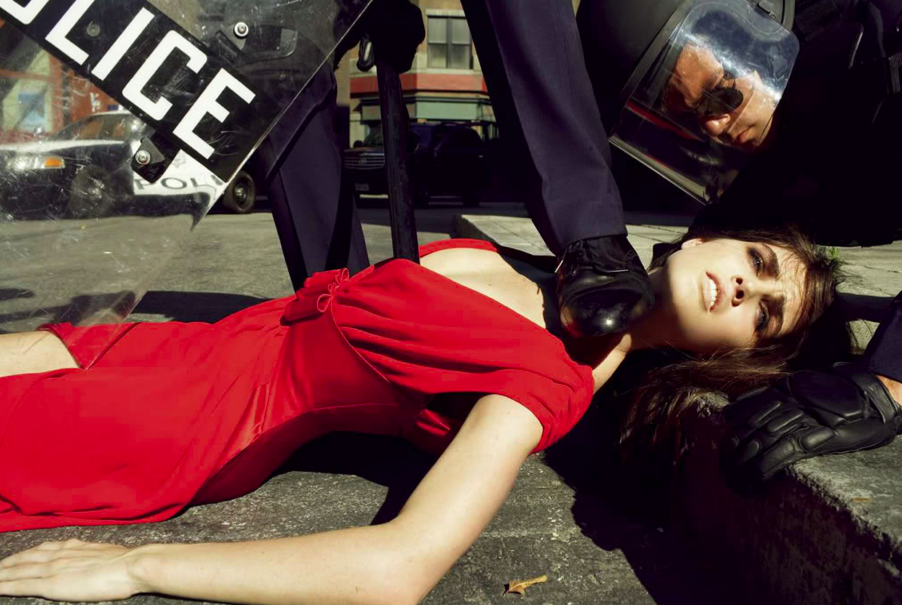
Above and below are two different critiques of the power of appearances. Meisel uses the fashion editorial to express social issues in "State of Emergency," 2005. Below Juergen Teller breaks down conventions of glamour in fashion photographer by showing the designers themselves in ordinary settings in the ads.


Above the proposal by Olivier Zahm that the commodity exchange of fashion is combined with the mystical impossible exchange (the singularity of the consumer, specific values and dreams) to make a successful fashion photograph. Below the proposition of Brian Morean that corporations uses the familiar and powerful appearances of celebrities to reach the consumer.


Morean proposes that celebrities have economic power and worth. Their faces and names bring added value to product presentations. The combinations of celebrity and fashion are not always successful as it is co-branding and there are many variables.


Finally, a participant in the power of appearances is the model who takes on different aesthetic expressions for different value assertions. The pressure toward "perfection" is a highly debated, often willing, oppression of the fashion system.


Some models take their position with empowerment, managing their bodies and careers like a business. Above Caroline Trentini and below the most successful examples, the 90's Supermodels.

Naomi Campbell, Linda Evangelista, Tatjana Patitz, Christy Turlington and Cindy Crawford by Peter Lindbergh for British Vogue January 1990

See fashion photography since the 1980's here
See the history of the fashion model here

Fashion and Graphics

By: Isabella Aballi

Tamsin Blanchard examines the power behind the label and how the emerging role of graphic designers has become key for a fashion labels success and credibility. Blanchard explains how the label has become its own form of currency because of the social and economic importance is holds. Nowadays, fashion brands have come to rely on packaging and presentation to determine its worth as oppose to the actual product. In the last 20 years, the graphic designers that are in charge of creating the labels and the presentation have created the ability to attach status and power to labels and fashion industries. Fashion is no longer just clothes; now the fashion industry has many sectors that contribute to the popularization of the label. These graphic designers create fashion show invitations, ad campaigns, �look books, catalogues, press mail-outs, magazines, etc��all of these elements contribute to the message attached to the label.

Peter Saville is known for being the pioneer of fashion graphics. He collaborated with photographers like Nick Knight and produced work for designers like Yohji Yamamoto. Yohjis catalogue in 1986 was a groundbreaking innovation for the fashion world and kicked off the field of fashion graphics. In fashion graphics it�s a matter of presentation as oppose to the fashion itself. For example, some people like certain brands because of the message that is communicated through the presentation of the clothing.


Many designers have reestablished themselves simply by changing their ads and presentation of fashion (Stella McCartney, Burberry, etc). �A brand�s graphic identity is how it expresses itself, shows what it wants to belong to and talks to its customer with its chosen visual language. The graphic identity will be applied to everything that the brand uses so it is vital to find an expression that suits its values.�
Once a designer creates te=he product and determines a message they want to send, every form of that brands representation is formed around that identity: the logo, the lookbook, the colors, the models, everything.

YSL is seen to be the label to prove the power of the graphics the most through its elegant letters Y � S � L which are known worldwide regardless of whethere you own a piece of haute couture or not.


VS.


The first graphic designers are said to have worked in the music industry before the fashion industry.

�Fashion houses no matter how mainstream need ti keep a step ahead if they want to maintain their credibility��essentially they have to be innovative but keep their elegance.

�At best, graphic designers have brought to the fashion industry another set of eyes, a fresh perspective and an uncompromising vision. At worst, they are simply another marketing tool.�

�If it looks good, don�t trust it.�

�Presentation is in danger of becoming everything.�

Monday, March 21, 2011

Celebrities, Culture and a Name Economy By: Brian Moeran

Brian Moeran discusses the effects celebrities have in our society by splitting the essay up into four different sections. A professor in the Department of Intercultural Communication and Management at Copenhagen Business School he is concerned about different social processes dealing with cultural production such as advertising, fashion and media. He uses a theoretical approach by examining the different shifts celebrities have created in the commercial industry. He believes culture and economy are connected and celebrities are the liaison for these industries as they deliver the perspective the company wants to appeal, to the consumers.

Celebrities
"The celebrities are the Names that need no further identification...Wherever they go, they are recognized, and moreover recognized with some excitement and awe," (Morean3).
Celebrities first came about in New York City Cafes towards the end of the 20th century at the time where different classes of people intermingled. Or he says it might have came from the time motion pictures first came about from 1909 through 1914 when names were being circulated with films. Stars were used as promotional tools for films it didn't really matter what they were good at, as long as they were popular and associated themselves with other celebrities to become more exclusive and well-known. Celebrities at the same time go into all different industries such as acting, directing, photography, television commercials and fashion designing, being a part of these other social intermediaries initiates recognition. Ex: Naomi Campbell is a supermodel, cinema, music videos, and publishing.


Celebrities and Advertising
Celebrities are important when they channel meaning from one sphere of culture to another. Celebrities are the strongest source of cultural meaning in the marketing system and for individual consumers. They enjoy recognition being associated with a consumer good while in an advertisement. The first point he makes it that he says there should always be a match between the product and celebrity. John Wayne was a great liaison for Great Western Savings and Loans. He fit the criteria for the company�s image with the western cowboy look. Tigerwoods the greatest golf player is associated with all golf related things, such as Golf Digest and American Golf Association. Various other factors are considered when picking a celebrity such as fashion, beauty, and cosmetics. Credibility and expertise are two factors when choosing a celebrity to market the companies product. The gender, age, class, color and personality all have to fit the targeted consumer as well. Morean states through McCraken that sometimes using celebrities is not good since sometimes the audience only focuses on the celebrity and not the product.


Also with celebrities, companies take a risk on the possibility that a celebrity they endorse will be a part of something controversial that will make the brand look bad. Although when picking a celebrity personality, attractiveness and likeability is looked for, it is noted that consumers do not consider those factors when purchasing products. But celebrities in general do help the global market in getting the brand out worldwide.

Celebrities as Cultural Intermediaries
Celebrities are cultural intermediaries because they are in all different kinds of media linking different cultural spheres together. Celebrities link the commodities, the products with cultural personality linking producers and consumers together by making a product a good that is necessary for everyone in society. They also explain and support the meaning of the commodity and affect the overall aesthetic and design of the advertising campaign.

Celebrity and The Economy
Celebrities help link our cultural surrounding and economy together. For example celebrity endorsements, for Tiger Woods earns up to $50 million a year in endorsements. Kate Moss gets $4Million a year at Calvin Klein only working 100 days. They are also involved in many business themselves as for Madonna has founded her own recording company called the Maverick and Cindy Crawford has her own jewelry line.
Celebrities can be considered as investments as well for example in 1995 when rumors stated that Michael Jordan would be coming back to the Chicago Bulls, the stock prices for the companies he was affiliated with such as McDonalds stated their stock prices sky rocketed and they predicted they would gain $192 million in additional sales from the Value Meals.

Brian Moeran concludes by stating that celebrities are necessary factors in promoting goods and getting the industry running. Economy is interlocked with people, product and organizations; all three need to work together for the economy to run. �Celebrities by the products they endorse and the organization they work for- are involved in a vast operation of social alchemy� (Moeran12).


Moeran, Brian. "Celebrities, Culture and a Name Economy." (2003): 1-18. Print.

The Decline of the Haute Couture Power House: Is it Immortal?


The term �Haute Couture� is one that is tossed around quite often when discussing high-end fashion and clothing, but what exactly is it? The direct translation from French is �high sewing� or �high dressmaking� referring to the creation of exclusive custom fitted clothing. Haute couture is made to order for a specific customer, and it is usually made from high quality, expensive fabric, and hand sewn with extreme attention to detail with the use of time consuming, hand executed techniques that one must be highly trained in.
Haute Couture made its debut more than a century ago in the middle years of the nineteenth century in Paris and the fashion world was in awe of the novelty and modernity of the Haute Couture Aesthetic. In the mid-nineteenth century, Englishman Charles Frederick Worth burst onto the Paris scene with a new philosophy of how clothes should be made. By creating branded fashion design, Worth created the very first Fashion House. After Worth, the trend of Haute Couture became the norm for upper class women who were willing to spend money on luxurious clothing items.
The Chambre Syndicale de La Couture was developed by Worth and his sons to determine which design houses were truly Haute Couture Houses. The Chambre Syndicale de la Haute Couture Parisienne was created in 1868 stemming out of the Chambre de Commerce et d�Industrie de Paris to govern the rules of Parisienne Haute Couture. By 1946 there were 106 Official Haute Couture Houses with the criteria for being an Haute Couture House established in 1945.
By 1952 that number dropped drastically to 60 Haute Couture Houses. This was mostly due to the Second World War creating a great change in the fashion industry and mass-manufactured fashions became increasingly popular. The idea of custom made clothing that was both extravagant and time consuming to make became unjustifiable. With the emergence of street and fast fashion quickly growing, Paris needed to figure out a way to protect its Haute Couture roots, and keep the true Paris couture houses as well known and respected establishments. The Federation Francaise de la Couture was created in 1973 growing out of the Chambre Syndicale de la Haute Couture Parisienne to do just this. The Federation is responsible for setting the dates and locations of the French fashion weeks.
Within the F�d�ration the Syndicale is a body that promotes, , educates, represents, defends, deals with social and working benefits and advises its members in all relations between labor and management, including great names of the Paris couture world. It also establishes industry standards on quality and on the use of the word "haute couture". Their rules state that only "those companies mentioned on the list drawn up each year by a commission domiciled at the Ministry for Industry are entitled to avail themselves" of the label haute couture. To earn the right to call itself a couture house and to use the term haute couture in its advertising and any other way, members of the Chambre Syndicale de la Haute Couture must follow these rules: Design made-to-order for private clients, with one or more fittings, must Have a workshop (atelier) in Paris that employs at least fifteen to twenty people full-time, and Each season (i.e., twice a year), present a collection to the Paris press, comprising at least thirty-five looks (at least 75 new designs a year) with outfits for both daytime wear and evening wear.
After these extremely strict rules were put in place the number of official Haute Couture houses had gone down to just 18 by the year 2000. By January 2002, at the time of Yves St. Laurent�s sad departure from the fashion industry into retirement there were only 12 couture houses left. In 2003 and 2004 famed designers Donatella Versace and Emanuel Ungaro stopped doing couture shows respectively. Now there are 11 official members of the Federation Francaise de la Couture. Those members are Adeline Andre, Anne Valerie Hash, Atelier Gustavo Lins, Chanel, Christian Dior, Christophe Josse, Franck Sorbier, Givenchy, Jean Paul Gaultier, Maurizio Galante, and Stephane Rolland.
With only 11 members left, how long until the Federation Francaise de la Couture is gone for good? The exclusivity of the Federation means enhanced values to the status conscious consumer but those who can and still choose to wear Haute Couture are an aging clientele. Even extremely wealthy younger women, who could in theory afford couture, often find ready-to-wear clothes more practical, wearable, and fun.
Because of that there is no way that Fashion Houses can rely on Haute Couture for their main income. For most houses, their twice-yearly Haute Couture shows lose them money. ). The big four operators of Couture � Chanel, Dior, Givency, and Gaultier � use couture as a marketing tool and make money of off their ready-to-wear, fragrance, and accessory lines.
If you remove the rules of the Federation Francaise de la Couture, than the actually act of creating Haute Couture, or made to order high quality clothing, is still alive and well. It is just no longer something one can only find at an official Parisian Couture House. Custom-made clothes are making a big come back, and people will always want their own unique pieces. Especially popular is the man�s custom made suit, dresses, wedding gowns and raincoats.
It seems at the now Haute Couture of an actual house recognized by the Federation Francaise de la Couture is simply a marketing tool which captures the public�s imagination, or will it, sadly, disappear altogether.

Herm�s Case Study

By: Valentina Franco


Herm�s is a major fashion company that prides itself on its heritage, craftsmanship and luxury. It started in 1837 as a harness shop in Paris for horses and carriages, and later expanded onto the production of saddles. By the 1900�s, Herm�s started to create travel bags, handbags, belts, gloves, and other leather goods that resemble the products that are available today. Since its establishment by Thierry Herm�s, the Herm�s family has been in charge of the business, so far having six generations of Herm�s heirs at the forefront of the company.

The Herm�s Family Directors through the Years


Two of the most recognized Herm�s products are the Kelly bag and the Birkin bag. The Kelly bag was introduced in 1935 as the �sac � d�p�ches� but it was made famous in 1956 by American actress and then Princess of Monaco, Grace Kelly when she used it to cover her pregnancy from the paparazzi. The Birkin bag was created in 1984 for English singer and actress Jane Birkin, after she ran into Robert Dumas in a flight from London to Paris and heard her complain that she didn�t have a proper bag to carry all the things she needed to put in a handbag. Both of these handbags are a status symbol since their economic value is extremely high. These bags are unique and recognizable, carrying with them an aura of prestige and luxury unlike any other bag.

Grace Kelly covering her pregnancy with an Herm�s bag


Video: The Herm�s Saddle Stitch

http://www.youtube.com/watch?v=9fHYcnrSie8v


The past year, 2010, was a very profitable year for Herm�s which explains LVMH�s interest in purchasing part of Herm�s� stock. By December 2010, LVMH had purchased 20.2% of Herm�s� shares, which triggered a very negative reaction from the company�s CEO Patrick Thomas, and all the Herm�s family heirs. Threatened by the differences between Bernard Arnault�s vision and business perspective and Herm�s� traditional and exclusive views, Herm�s decided to apply to the Board of the Autorit� des March�s Financiers (AMF) in order to create a holding company with 51% of Herm�s� family shares. In January 2011, the AMF ruled in favor of Herm�s� petition, and therefore protected the legacy and tradition of the French company Herm�s.


Herm�s ad video "La Vie Comme une Conte" Automne/Hiver 2010

http://www.youtube.com/watch?v=sqwLITEp_vo

PPR Gucci Group Case Study

By Sophie Cheung


The PPR Gucci Group, formerly known as Pinault-Printemps-Redoute, was founded in 1963 by Francois Pinault. Currently, the company is run by his son, Francois-Henri Pinault and specializes in the design, manufacture, and marketing of luxury goods. The Luxury group brands of PPR include:Gucci
  • Bottega Veneta
  • Yves Saint Laurent
  • Balenciaga
  • Alexander McQueen
  • Boucheron
  • Sergio Rossi
  • Stella McCartney
  • Puma (subsidiary brand)
The company's power comes not only from its control over the creme de la crop of luxury brands, which has enabled it to dictate style to the upper echelons of society and the masses, but also from the company wealth and influential power of the Pinault family.


A keyword search on sites such as Business of Fashion and The New York Times shows PPR as having one of the foremost number of related articles with LVMH as a close industry rival. The search results for PPR are well up into the thousands, which show industry power as media attention circulates around those that are deemed important enough to receive it. More than that though, the Pinault family also owns a significantly influential sector of the French Media through the family owned company Groupe Art�mis.


The Pinault family also owns the world's most renowned art collection and Francois Pinault was awarded the most influential person in contemporary art for two years straight in 2006
and 2007 respectfully. Additionally, the family also owns the prestigious Palazzo Grassi--a modern art museum in Venice in as well as the world's leading art auction house Christie's. Their power and influence thus extends beyond fashion as their control over the art world lends them the ability to dictate creativity and aesthetics in general.

 
Design by Free WordPress Themes | Bloggerized by Lasantha - Premium Blogger Themes | Grants For Single Moms